A plain-English guide to the six documents every Florida adult should know about.
Karia LawFlorida · South Florida roots
Publisher’s note
Educational information, not legal advice
This guide is published by Karia Law for general educational purposes. It is not legal advice and reading it does not create an attorney-client relationship. Florida law changes, and individual situations vary. For guidance specific to your circumstances, consult a licensed Florida attorney.
6
core documents explained
7
short, practical chapters
1
organizer to print and keep
Karia Law · Florida Estate Planning Guide
Chapter 00
Your Florida Estate Plan, Simplified
Educational information, not legal advice
This guide is published by Karia Law for general educational purposes. It is not legal advice and reading it does not create an attorney-client relationship. Florida law changes, and individual situations vary. For guidance specific to your circumstances, consult a licensed Florida attorney.
6
core documents explained
7
short, practical chapters
1
organizer to print and keep
Karia Law · Florida Estate Planning Guide
Chapter 01
Why Florida Is Different
Florida does not have a state estate tax or a state income tax. But it does have something most other states do not: constitutional homestead protection.
Your primary residence in Florida is not just protected from creditors in most cases. The Florida Constitution also restricts how you are allowed to leave it to your heirs if you have a spouse or minor children. That rule is one of the most commonly misunderstood areas of Florida estate planning, and it is a big part of why a will or plan written for another state does not automatically work here.
If you do not have a plan at all, Florida's intestacy law decides who gets what, and it does not ask what you wanted. It follows a fixed formula based on your family structure. For many families, especially blended families, that formula can produce a result nobody intended.
Fla. Const. Art. X, § 4; Fla. Stat. Ch. 732.
Figure 1.1
If there is no will
Florida’s intestacy statute follows family structure—not unwritten wishes.
Explore the chart details
Starting pointAssets subject to intestacy
01
Spouse, no children
Spouse receives 100%
02
Spouse + children from that marriage only
Spouse receives 100%
03
Spouse + children from a prior relationship
Spouse 50% · Children 50%Often surprises blended families
04
No spouse, children only
Children split equally
05
No spouse, no children
Parents first, then siblings
Simplified examples for illustration, not an individualized legal result. See Fla. Stat. Ch. 732.Compare the outcomes in a table
Florida intestacy at a glance
Family situation
Result under Florida law
Spouse, no children
Spouse: 100%
Spouse + children from that marriage only
Spouse: 100%
Spouse + children from a prior relationshipThe scenario that surprises people
Spouse: 50% / Children: 50%
No spouse, children only
Children split equally
No spouse, no children
Parents first, then siblings
Simplified for illustration. Consult a Florida attorney for your specific situation.
Karia Law · Florida Estate Planning Guide
Chapter 02
What Happens Without a Plan
Does a will avoid probate?
No. This is one of the most common misunderstandings in estate planning. A will does not skip probate. It gives the probate court your instructions. Every asset that passes under a will still goes through Florida's court process.
What happens if I die without a will?
Your estate passes under Florida's intestacy statute (Chapter 732, Florida Statutes). It is a mechanical formula based on who is related to you and how, not a reflection of your relationships or wishes. For blended families in particular, the result can be surprising.
What is the actual cost of waiting?
Every extra document you are missing tends to mean more time, more court involvement, and more cost for the people you leave behind. It is rarely one big decision. It is usually several small documents that are simple to put in place now and expensive to be without later.
Figure 2.1
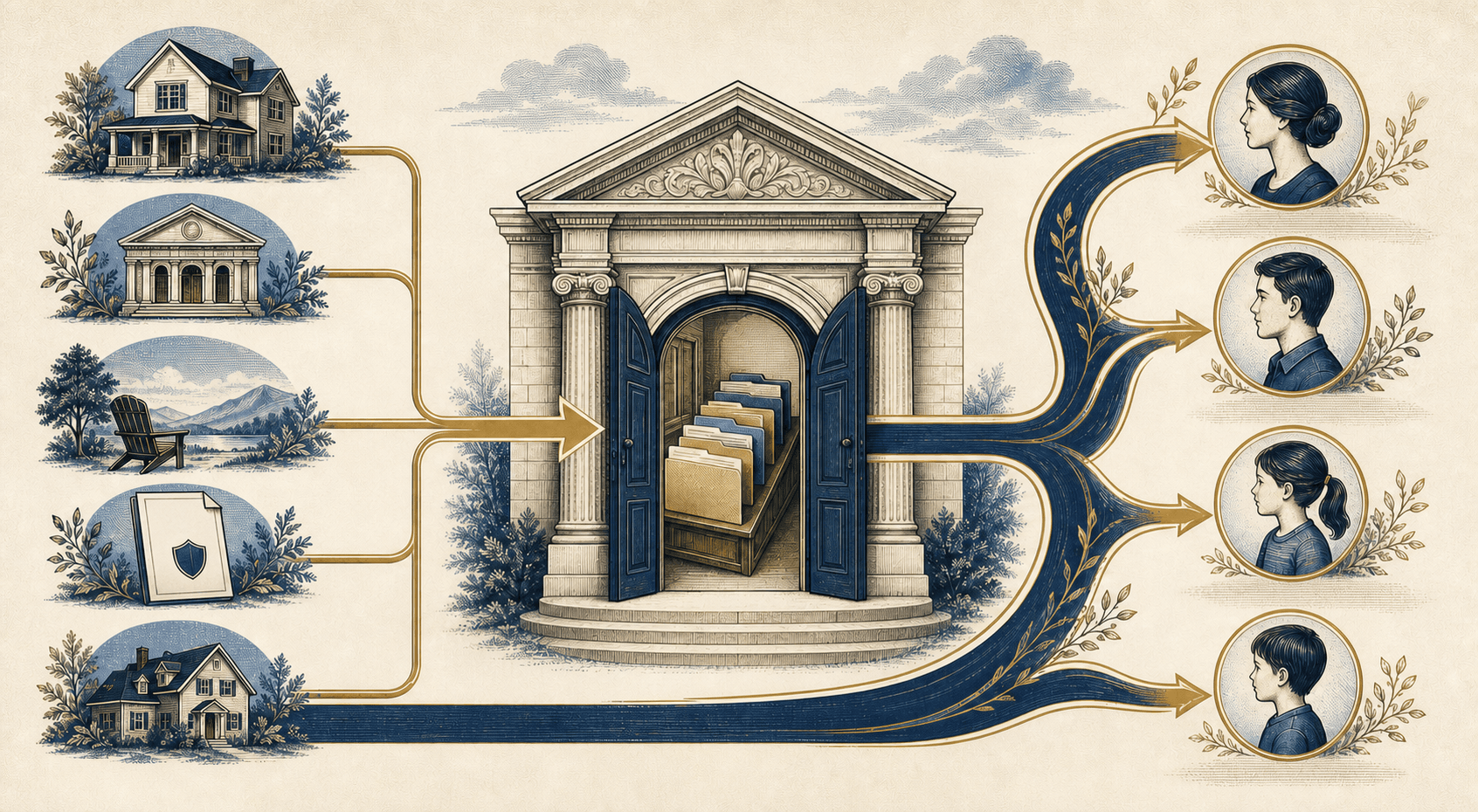
How an asset travels after death
The route depends on title and beneficiary arrangements—not simply on whether a will exists.
Explore the chart details
$
Start with one assetHow is it titled or directed?
Route ACourt-guided probate
Solely titled assets
Assets passing under a will
Bank account without beneficiary or POD
Real estate titled only in the deceased’s name
Route BDirect-transfer mechanism
Named life insurance or retirement beneficiary
POD or TOD account
Joint ownership with right of survivorship
Florida property covered by a Lady Bird Deed
Examples are simplified. Account agreements, title, beneficiary forms, and individual circumstances matter.Compare the routes in a table
Probate vs. non-probate
Goes through probate
Bypasses probate
Assets titled solely in the deceased's name
Life insurance with a named beneficiary
Assets passing under a will
Retirement accounts (401(k), IRA) with a named beneficiary
Bank accounts with no beneficiary or POD designation
POD / TOD accounts
Real estate titled only in the deceased's name
Jointly owned property with right of survivorship Lady Bird Deed property
Cost of missing documents
Missing document
Overall impact
Public record
Last Will & Testament
High
Yes
Durable Power of Attorney
High
Yes
Health Care Surrogate
Medium
No
Living Will
Low
No
HIPAA Authorization
Medium
No
Lady Bird Deed
High
Yes
Impact levels are general. Individual circumstances vary.
Karia Law · Florida Estate Planning Guide
Chapter 03
The Six Documents
Figure 3.1
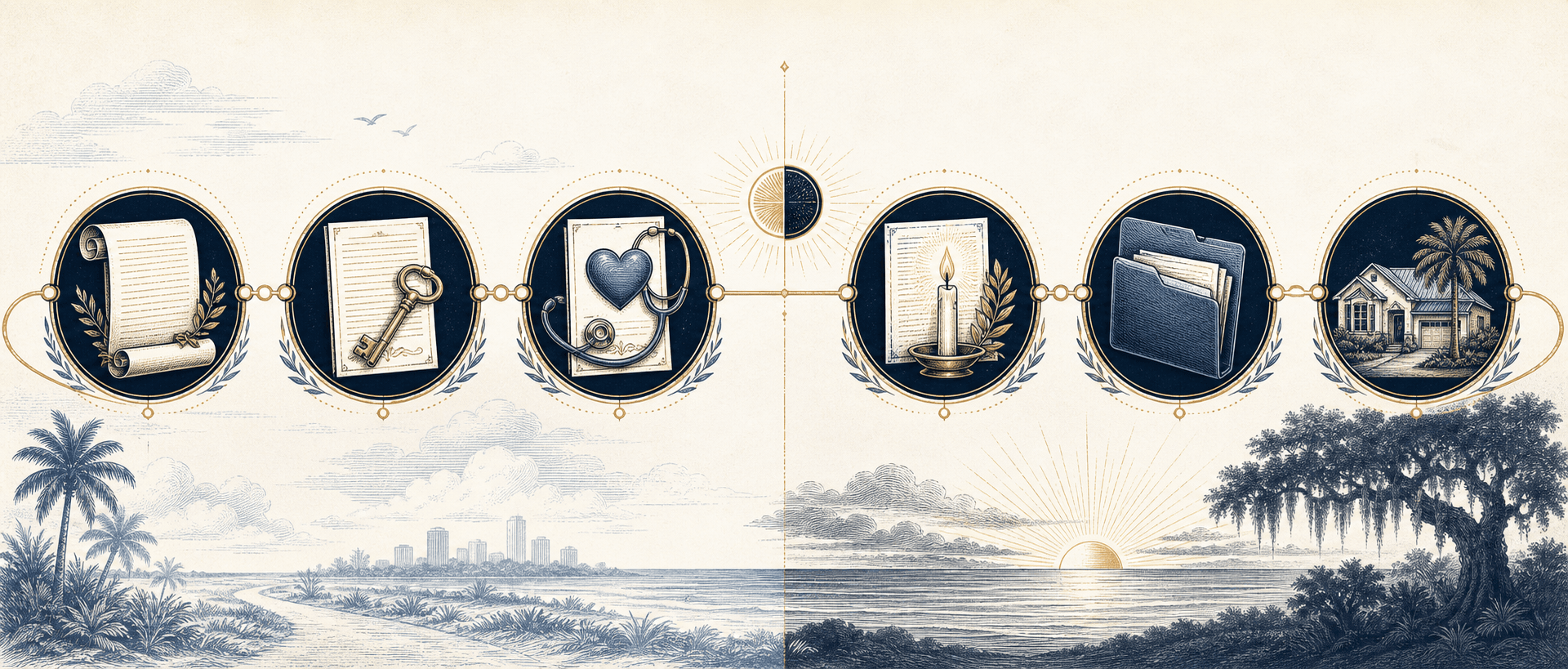
Your plan across a lifetime
The six documents work at different moments and answer different questions.
Explore the chart details
While you’re aliveAt death
Lifetime authorityPrepare for a moment when you cannot act
Financial + legalDurable Power of Attorney
Your agent can handle authorized affairs while you are alive.
Who?Health Care Surrogate
Names who makes medical decisions.
What?Living Will
States defined end-of-life wishes.
Access?HIPAA Authorization
Controls who may see health information.
At deathDirect where property goes
Via probateLast Will & Testament
Directs assets that pass under the will.
Deed mechanismLady Bird Deed
Addresses the described Florida property.
A will and Lady Bird Deed address property at death through different mechanisms. The medical documents divide decision-making, wishes, and information access.Compare all six documents in a table
How the six documents relate
Document
Category
What it covers
Last Will & Testament
At death
Assets, via probate
Lady Bird Deed
At death
Property, bypasses probate
Durable Power of Attorney
Lifetime authority
Financial and legal affairs while you are alive
Health Care Surrogate
Medical — who decides
Names who makes medical decisions
Living Will
Medical — what you want
States your end-of-life wishes
HIPAA Authorization
Medical — access
Who can see your medical records
01
At death · Probate
Last Will & Testament
A will says who gets your property after you die and names your Personal Representative, the person responsible for carrying out your wishes and managing the process. It is also the most common document used to name a guardian for minor children.
Do I need a lawyer to write a will in Florida?
No. Florida allows you to prepare your own will. What matters is that it is done correctly: it must be signed by you and witnessed by two people who sign together, in your presence and each other's. Skip any part of that, and a court can find the will invalid—functionally the same as having no will at all.
Does a will avoid probate?
No. A will directs probate; it does not replace it. If avoiding probate entirely is the goal, that is a conversation about other tools, especially when your situation is more complex than one home and a straightforward family structure.
Is a handwritten will valid in Florida?
Only if it is properly witnessed. Florida does not recognize handwritten or spoken wills that skip the witnessing requirement, no matter how clearly they express your wishes.
Who commonly has one? Every Florida adult with property, minor children, or specific wishes about who receives what typically has one, including people who also have a trust. A will catches anything the trust does not cover and is the most common place to name a guardian.
Fla. Stat. § 732.502.
02
While alive · Financial
Durable Power of Attorney
A durable power of attorney names someone—your agent—to manage your financial and legal affairs. “Durable” is the key word: the document keeps working even if you later become unable to make decisions yourself. Without that language, a power of attorney stops working at the moment it is usually needed most.
What makes it “durable” in Florida?
Florida law requires specific wording stating that the agent's authority continues after you become incapacitated. Leave it out, and the power of attorney ends automatically, potentially leaving your family to petition a court for guardianship.
Can a bank reject my power of attorney?
Yes. Banks regularly reject documents that do not meet Florida's requirements—missing witnesses, missing notarization, vague language, or an out-of-state template not built for Florida law. If a bank rejects it, it is required to give you a written reason.
Does it end at death?
Yes. A power of attorney only works while you are alive. At death, your Personal Representative takes over under your will and the agent's authority ends.
Who commonly has one? Any adult who wants a trusted person able to step in on financial matters without a court process. This is not just an “elderly” document: anyone 18 or older can unexpectedly lose the ability to act, and family members have no automatic authority without one.
Fla. Stat. Ch. 709; execution requirements at § 709.2105.
03
Medical · Who decides
Health Care Surrogate
A Health Care Surrogate designation names the person who can make medical decisions and access your health information if you are unable to make those decisions yourself. Think of it as answering one question: who speaks for me?
What does this let someone do?
Talk to your doctors, see your medical records, and make treatment decisions on your behalf when you cannot. You can also choose to let your surrogate access your health information before incapacity, which can be useful during a hospital stay.
What if my surrogate is unavailable?
Florida allows you to name co-surrogates or a successor surrogate. For snowbirds, naming a Florida-based surrogate and an out-of-state surrogate can make it more likely that someone is reachable when a quick decision is needed.
How is this different from a Durable Power of Attorney?
A power of attorney can include medical authority, but Florida treats health care decisions separately in practice, with their own form and witnessing requirements. Most complete plans include both: a surrogate for medical decisions and a power of attorney for everything else.
Who commonly has one? Every adult, not just people managing a health condition. Hospitals and doctors need to know who to talk to the moment you cannot answer for yourself, at any age.
Fla. Stat. Ch. 765; execution requirements at § 765.202.
04
Medical · What you want
Living Will
A living will states your wishes about life-prolonging treatment if you are ever in an end-stage condition, terminal condition, or persistent vegetative state. It is not about everyday medical decisions.
How is this different from a Health Care Surrogate?
Your Health Care Surrogate says who decides. Your Living Will says what you want for end-of-life treatment. In many plans, the Living Will speaks directly to your doctors.
When does it apply?
Only in the circumstances Florida law defines, generally requiring more than one physician to confirm the condition. It does not apply to short-term or recoverable situations and does not replace a Health Care Surrogate for everyday medical decisions.
Do I need both documents?
Most people benefit from both. They cover different situations, and having only one can leave a gap exactly when your family needs clarity most.
Who commonly has one? Florida adults who want their own wishes about end-of-life treatment documented directly, rather than leaving that decision to a surrogate to interpret.
Fla. Stat. § 765.302.
05
Medical · Information access
HIPAA Authorization
A HIPAA Authorization is often the most misunderstood document because people assume it does the same thing as a Health Care Surrogate. It does not.
Is this the same as a Health Care Surrogate?
No. A HIPAA Authorization lets someone see your medical records and health information. It does not give them authority to make decisions. Think: access versus authority.
Why would I need this separately?
It is useful in situations short of incapacity—for example, letting an adult child talk to your doctor about a diagnosis while you are still fully capable of making your own decisions but are not physically present.
Who commonly has one? Anyone who wants family members or a trusted person to get information from doctors and hospitals without a separate authorization scramble during a stressful moment.
45 CFR § 164.508.
06
At death · Florida property
Enhanced Life Estate (Lady Bird) Deed
An Enhanced Life Estate Deed, commonly called a Lady Bird Deed, lets you transfer your Florida home to chosen beneficiaries automatically at death, without probate, while you keep full control during your lifetime. You can still sell, mortgage, or change your mind. Florida is one of only a handful of states that recognizes this type of deed.
Figure 3.2
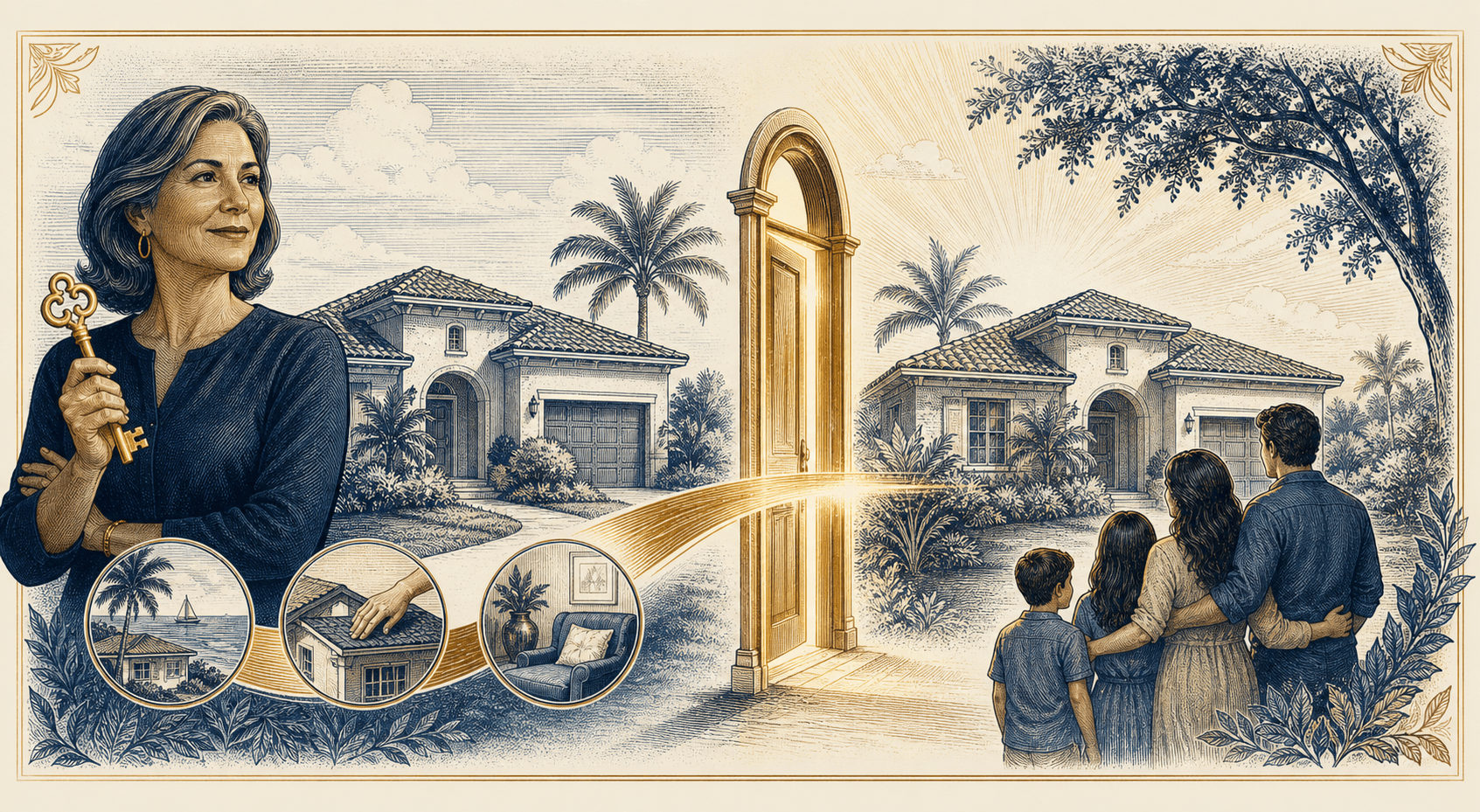
Control now. Transfer later.
A Lady Bird Deed separates what the owner may do during life from what happens to the described Florida property at death.
Explore the chart details
Today
You retain control
May sell
May mortgage
May change your mind
At death
Later
The deed mechanism operates
The described Florida property moves to the named beneficiary without probate for that asset.
Florida property only. Real estate in another state needs its own planning.
What is the advantage over a will?
A will still requires probate for your home. A Lady Bird Deed transfers the property directly to named beneficiaries when you die, without a court process for that asset, while you retain control during life.
Does it help with Medicaid planning?
Some people use it as part of a broader Medicaid planning strategy. This is a specialized, evolving area of law and should be discussed directly with an elder law attorney.
Does it cover property outside Florida?
No. It covers only the property described in the deed, located in Florida. Real estate in other states needs its own planning.
Who commonly has one? Florida homeowners who want their home to pass directly to named beneficiaries without probate while keeping full control during life.
A document that says the right things but is not executed correctly can be challenged, rejected, or thrown out entirely.
Florida has specific signing rules for each of the six documents, and they are not all the same. This is a quick reference, not a substitute for the instructions that come with each document.
Requirements at a glance
Document
Witnesses
Notary
Recording
Last Will & Testament
2, signing together in each other's presence and the testator's
Not required to be valid; a notarized self-proving affidavit avoids extra probate steps
No
Durable Power of Attorney
2
Required
No
Health Care Surrogate
2; at least one is not a spouse or blood relative
Not required
No
Living Will
2; same rule as Health Care Surrogate
Not required
No
HIPAA Authorization
Not required
Not required
No
Lady Bird Deed
2
Required
County Official Records
Last Will & Testament
The testator signs at the end of the will, or directs someone else to sign in their presence and at their direction. Two witnesses sign together, in the presence of the testator and each other. Florida does not recognize a will that skips this step, no matter how clearly it states the person's wishes.
A self-proving affidavit is a short notarized statement attached to the will. It is not required, but without it, the witnesses may need to be tracked down and sworn in during probate. Most people execute it at the same signing appointment.
Fla. Stat. § 732.503.
Durable Power of Attorney
The principal signs in front of two witnesses and a notary, all at the same time. Chapter 709 requires this exact combination. A DPOA signed without a notary present is not durable in Florida, even if it says so on the page.
Health Care Surrogate and Living Will
Both are signed by the principal and witnessed by two people. At least one witness cannot be the principal's spouse or blood relative. No notary is required. Many people sign both at the same appointment since they cover related ground: who decides and what you want regarding end-of-life treatment.
HIPAA Authorization
A signature is enough—no witnesses and no notary. Some health systems have their own HIPAA form, so confirm that your document will be accepted before an appointment or hospital stay is underway.
Lady Bird Deed
The grantor signs in front of two witnesses and a notary. What makes this document different is what happens next: it must be recorded in the Official Records of the county where the property is located. An unrecorded Lady Bird Deed does not accomplish its purpose. Recording typically involves a small per-page fee and, in some counties, documentary stamp requirements depending on the deed's terms.
Where to file or record
Document
Where it lives
Last Will & Testament
Original kept safe; not recorded publicly during your lifetime
Durable Power of Attorney
Kept with the principal; copies to the agent and relevant institutions; recorded only if used for a real estate transaction
Health Care Surrogate
Copies to surrogate, physician, and hospital of choice; not recorded
Living Will
Copies to surrogate, physician, and hospital of choice; not recorded
HIPAA Authorization
Copies to whoever needs access; not recorded
Lady Bird Deed
Official Records of the county where the property sits
Karia Law · Florida Estate Planning Guide
Chapter 05
Life-Stage & Scenario Call-Outs
The right approach often depends on the shape of your family, where you split your time, and which assets or obligations stretch beyond Florida's borders.
Blended Families
The core issue: a will is not the only document that controls where assets go.
Life insurance, retirement accounts, and payable-on-death accounts have their own beneficiary designations, and those designations override the will. Someone can update a will after a new marriage or child and still have an old 401(k) form sending everything to an ex-spouse or one child.
What commonly comes up
Beneficiary forms never updated after remarriage or divorce
Providing for a current spouse during life while preserving assets for children from a prior relationship
Homestead property, where a surviving spouse's rights can limit what a will is able to do
Snowbirds and Relocators
The core issue: Florida residency affects more than taxes. People who split time between states often ask whether they need entirely new documents once they establish Florida residency.
Advance directives and powers of attorney validly executed in another state are generally honored in Florida. This is usually a review situation, not a start-over situation.
A will's validity in a Florida probate court can depend on the formalities of the state where it was executed. Confirm rather than assume.
Homestead status is tied to where someone actually lives and declares residency. It affects property tax exemptions and how property can be devised.
People who own property in more than one state sometimes need documents in each state. A Lady Bird Deed only reaches Florida property.
Fla. Stat. §§ 765.112, 709.2106, 732.502(2).
Multigenerational Households
The core issue: Florida documents govern Florida assets and decisions. They do not reach outside the state or country.
Many households are caring for aging parents, coordinating decision-making across generations and time zones, and managing family assets or obligations outside Florida or the United States.
What Florida documents can help with
Naming a Health Care Surrogate, co-surrogates, or successors to make medical decisions
Naming a trusted family member, co-agents, or successors in a Durable Power of Attorney
Creating a will that reflects the family's wishes instead of Florida's default intestacy formula
The Throughline
These six documents do real, useful work, but they work within Florida and alongside beneficiary forms, other states' documents, and obligations abroad that they cannot reach or override. Knowing where that edge is matters as much as knowing what the documents do.
Karia Law · Florida Estate Planning Guide
Chapter 06
Get-Organized Checklist
Your documents do their job only when the people who need them can find them and know what else exists.
This organizer is meant to sit alongside your documents, not replace them. Print this chapter and keep it somewhere your family can find it. Do not include full account numbers or passwords.
Accounts
List just enough for someone to know what to look for.
Account type
Institution
Notes
Primary checking
Savings
Retirement (401(k), IRA, etc.)
Investment / brokerage
Life insurance
Credit cards
Mortgage / loans
Other
Beneficiary Designations
Review this after any major life change: marriage, divorce, a new child, or a death in the family.
Account
Current beneficiary
Last reviewed
Life insurance
401(k) / retirement accounts
Payable-on-death bank accounts
Transfer-on-death brokerage accounts
Other
Passwords and Digital Access
Do not write passwords here. Record where that information lives so someone knows where to look.
Type
Where it is stored
Password manager
Email account
Online banking
Social media / accounts to close
Phone / device passcodes
Key Contacts
Role
Name
Contact info
Attorney
Financial advisor
Accountant / tax preparer
Insurance agent
Personal Representative
Health Care Surrogate
Agent under Power of Attorney
Document Locations
Document
Location
Last Will & Testament
Durable Power of Attorney
Health Care Surrogate
Living Will
HIPAA Authorization
Lady Bird Deed (recorded copy)
Deed / title to home
Vehicle titles
Safe deposit box and key
Karia Law · Florida Estate Planning Guide
Chapter 07
Next Steps + Glossary
What to Do Next
If you have made it this far, you already know more about Florida estate planning than most people do before they need to.
01
If none of the six documents are in place
Many Florida residents begin with a Will, Durable Power of Attorney, and Health Care Surrogate designation. Other documents may address additional situations depending on your circumstances.
02
If your documents have not been reviewed recently
Marriage, divorce, a new child, a move to Florida, or a few years passing are good reasons to take another look—especially at beneficiary designations, which do not update themselves.
03
If your situation touches a high-stakes callout
A blended family with homestead property, a Lady Bird Deed involving a spouse or minor child, Medicaid planning, or assets outside Florida are moments to talk to a licensed Florida attorney rather than rely on a template.
The person named in a Power of Attorney to act on the principal's behalf.
Beneficiary Designation
The named recipient on an account, such as life insurance or a retirement account, who receives it directly regardless of a will.
Durable
Language in a Florida Power of Attorney stating that the agent's authority continues after the principal becomes incapacitated.
Enhanced Life Estate (Lady Bird) Deed
A Florida deed that transfers real property automatically at death without probate while the owner keeps full control during life.
Grantor
The person who creates and signs a deed, transferring an interest in property.
Guardian
A person appointed by a court to make decisions for a minor child or incapacitated adult. A will is the most common place to name a guardian for minor children. Florida also allows a standalone designation. (Fla. Stat. § 744.3046.)
Homestead
A Florida constitutional protection for a primary residence, including creditor protection and rules about devise when the owner has a spouse or minor children.
Incapacity
A legal and medical determination that a person is no longer able to make financial or medical decisions for themselves.
Intestacy / Intestate
Dying without a valid will. In Florida, the estate passes under the formula in Chapter 732 of the Florida Statutes.
Notary / Notarization
A formal witnessing process performed by a commissioned notary public, required for some Florida documents but not others.
Personal Representative
The person named in a will to gather assets, pay debts, and distribute property. Other states may use the term “executor.”
Principal
The person who creates a Power of Attorney and grants authority to an agent.
Probate
The court-supervised process of administering an estate after death. A will directs probate; it does not avoid it.
Recording
Filing a document with the county Clerk of the Circuit Court so it becomes part of the public record. Required for a Lady Bird Deed.
Remainder Beneficiary
The person named to receive property after the current owner's interest ends, often used with a Lady Bird Deed.
Self-Proving Affidavit
A notarized statement attached to a will that can simplify probate by avoiding the need to locate and question witnesses later.
Successor Surrogate / Co-Surrogate
An alternate or additional Health Care Surrogate named in case the first choice is unavailable.
Testator
The person making a will.
Witness
A person who watches a document being signed and signs to confirm it. Requirements vary by document.